|

College alumnus Mr. Ip Wing-chi (left) and moderator Professor Zheng Zemian (right)

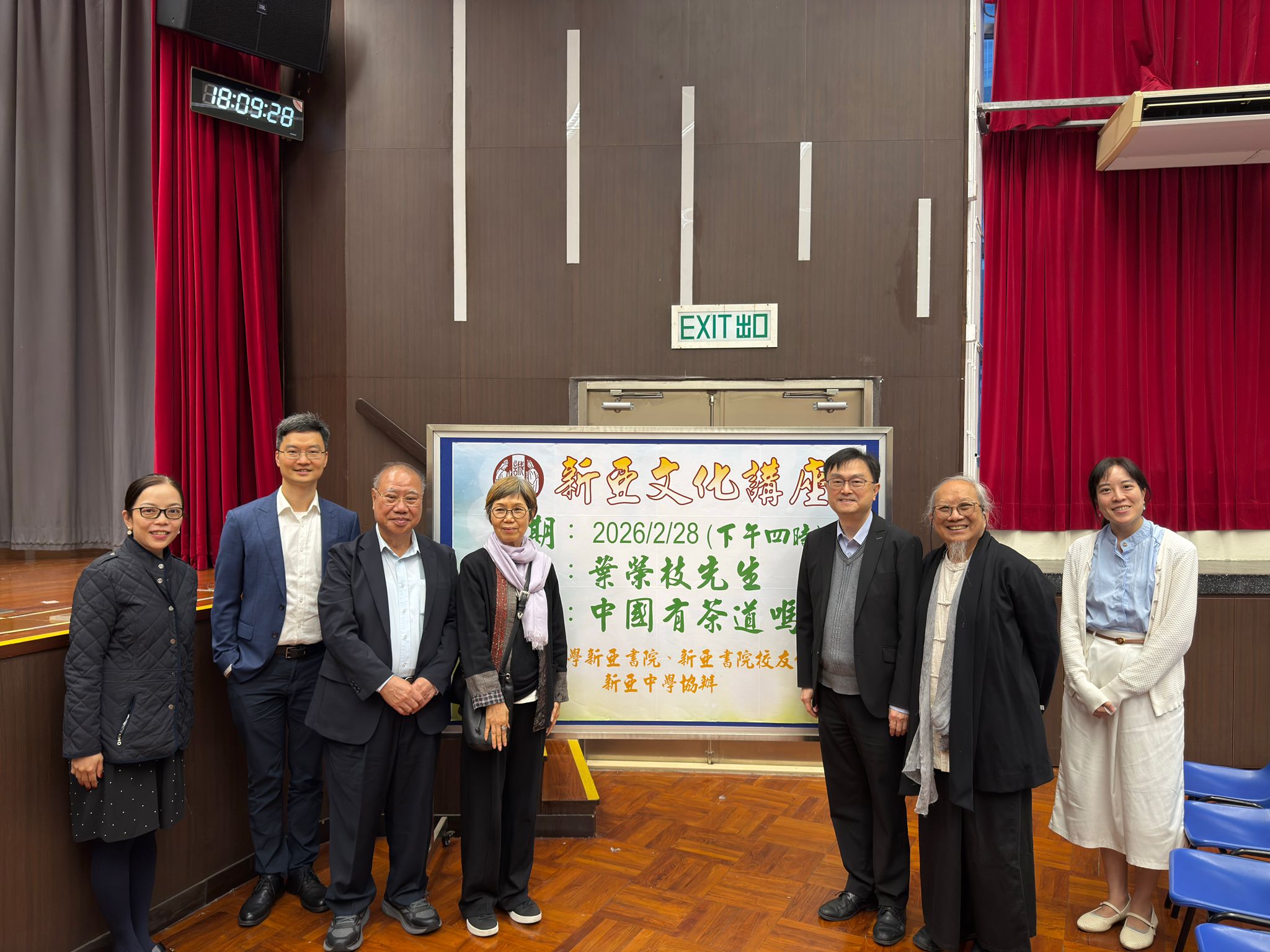
From left: Ms. Jean Luk, Professor Zheng Zemian (moderator), College trustee Mr. Wong Ho-chiu, Ms. Fung Chun-kam, Professor Sun-On Chan, College alumnus Mr. Ip Wing-chi (speaker) and Dr. Joyce Lee
|
[May 2026 issue]
The New Asia College Cultural Talk Series is co-organised by New Asia College and the New Asia College Alumni Association, with the support from New Asia Middle School. The second talk in 2025/26 was successfully held on 28 February 2026 at the School Hall of New Asia Middle School. The guest speaker was College alumnus Mr. Ip Wing-chi (77/Fine Arts), a renowned expert in tea culture.
Mr. Ip began the lecture by tracing the origins and evolution of Chinese tea culture — from early legends and archaeological findings to the foundational work of The Classic of Tea by Lu Yu in the Tang dynasty, as well as the refined tea practices developed during the Song dynasty. He highlighted that Chinese tea culture emphasises naturalness, simplicity, harmony and authenticity. Instead of adhering to rigid procedures, it focuses on cultivating inner disposition and appreciating the subtle beauty embedded in everyday life.
The lecture then turned to the transmission of tea culture to Japan. Through centuries of cultural and religious exchanges, Japan gradually developed its own tea culture — the “Tea Ceremony” — which has become increasingly formalised, particularly under the influence of Sen no Rikyu. The principles of harmony, respect, purity and tranquility, together with the well‑known concept of “ichigo ichie”, form the philosophical core of the Japanese Tea Ceremony. Mr. Ip noted that this structured and ritual‑based system stands in contrast to the fluid and spontaneous character of Chinese tea practices.
Addressing the central question “Is there a Tea Ceremony in China?”, Mr. Ip suggested that the key lies not in classification but in the differing cultural conceptions of “the Way”. In China, “Dao” is manifested through daily life, personal intuition and natural ease; while in Japan, it is realised through ritual discipline, aesthetic form and mindful cultivation. Despite their divergent approaches, both traditions lead toward reflections, serenity, and a deeper understanding of life.
The event received enthusiastic support from New Asia alumni, students and public audiences. Mr. Ip’s insights not only deepened the audience’s understanding of cross‑cultural tea aesthetics but also offered meaningful reflections on contemporary living and the pursuit of inner balance.
Lecture Review
|